History
of
St Matthew's Anglican Church Sherwood


Our Story
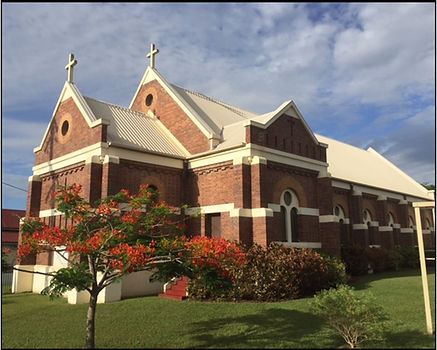
In 1868 the Church of England adherents in the Oxley Creek district declared themselves a congregation. Between 1868 and 1923 this congregation erected three churches dedicated to St. Matthew. The first two churches were built on the site of the present Anglican Cemetery in Sherwood Road, Sherwood, adjacent to Oxley Creek. The third Church is the beautiful brick Church situated at the intersection of Sherwood & Oxley Roads, Sherwood, now part of the Anglican Parish of Sherwood.
THE FIRST CHURCH OF ST. MATTHEWS
The Foundation Stone of the first church was laid on the 9th November 1869. The ceremony was performed by the Governor of Queensland, Col. S W Blackall, Queensland's second Governor, 1868 -1871. The site chosen for the Church described as:
This area was then known as West Oxley. Following the laying of the Foundation Stone the congregation attended a luncheon close by in a temporary arbor formed of green boughs, with approximately 200 present.
This first church was built of brick, with a stone foundation. It was of Gothic style, sufficiently altered to suit the climate, and cost approximately £300. ($600, possibly equal to $80,000 today). The length and breadth of the church from 'wall plate to wall plate' was 35 feet by 22 feet. It had a small chancel and vestry.
Worshippers at this time came from the numerous farms not only in the Oxley Creek district but also at Indooroopilly on the north side of the river, and from Yeerongpilly, Boggo, and other more distant places.
The steamer Walrus (shown above) transported approximately fifty passengers from Brisbane comprising clerical visitors and members of the Choir of St. John's Cathedral. Again the occasion attracted
The official opening of the Church occurred almost seven months later on the 6th June 1870. His Excellency, the Governor, Col. S. W. Blackall, was again present together with his Lordship, the Bishop of Brisbane, Dr. E. W. Tufnell, Sir James Cockle, Chief Justice, and a number of clergymen. Around 30 people from Brisbane travelled up the Brisbane River on the steamer 'Francis Cadell' to join the large number of residents gathered.
The weather was all that could be desired, and the country generally, and the farms in particular appeared in their best colours. The Church was described as being capable of holding 130 persons and set upon two acres of ground. A small choir was being formed, conducted by Mrs. Boyd, wife of the Master of the Primary School, who has lent her harmonium for the use of the Church. A number of the pews had been rented to members of the congregation for a fee of one guinea per annum (two dollars ten), still leaving ample room for free seats. A large Bible and Prayer Book were presented by Bishop Tufnell and were said to be the handsomest set of books in the Colony.
The Divine Service commenced at 12 o'clock in a crowded Church and was conducted by the Bishop assisted by the clergymen present. It was expected that Divine Service would be conducted every Sabbath alternately by the Reverend J.R. Moffatt and by a lay man. The Bishop delivered an eloquent sermon choosing as his text Acts 10:38. The collection at service amounted to £21.
A luncheon, comprising 200 persons, presided over by the Governor, was again held in a temporary erection of green boughs. Although there would be no toasts probably because of the religiosity of the occasion, His Excellency during his speech specifically honoured the name of Queen Victoria.
Alexander Boyd read a statement of accounts revealing that the land had cost £15/12/- and that in all the church had cost £370. The mortgage was £150 and the absolute debt was £211. The mortgage was to be paid off in a lump sum not by installments and it rested with the residents to take steps towards liquidating it'. Moreover, Boyd mentioned that a Mrs. Revell, probably the wife of early settler William Revell, had been the prime and indefatigable was incorporated in the bell at the former Holy Trinity Anglican Church, Darra. All records of the Cemetery were also lost in the fire.
True to the courage of these early settlers services were held as usual the next Sunday.
Morning services were held in the parish hall, then located adjacent to the Sherwood Railway Station.
Evening services were held in the local open-air picture theatre where, seated in canvas chairs the congregation listened to the rector the Rev’d George Green deliver an eloquent sermon and sang hymns displayed on the screen from lantern slides.
SECOND CHURCH
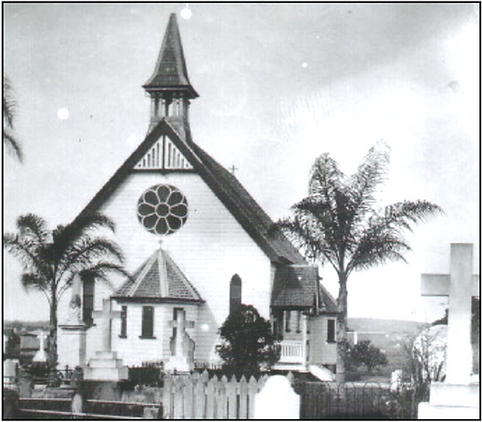
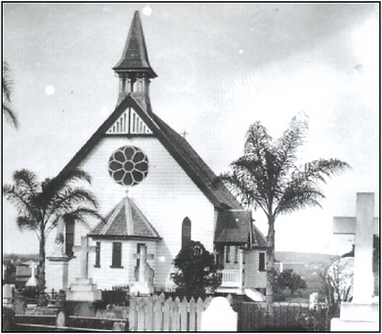
In 1893 the second Church, a pretty little timber one with its ornate octagonal window high in the west, was built to replace the deteriorating first church.
The first and second churches were still standing during the 1893 flood as can be seen in the photograph above. The water entered the new church causing the timber floor to bow and it remained like this for several years. (Note: the 1974 and 2011 floods had little impact on the Cemetery).
This second Church was totally destroyed by fire on the 27th September 1921, as shown above, to the dismay of all who had been associated with it and had learned to love it. The only thing salvaged were the Processional Cross, which is still in use in the present Church and the tongue of the bell, which was incorporated in the bell at the former Holy Trinity Anglican Church, Darra. All records of the Cemetery were also lost in the fire.
A fete held to raise funds to build a new church was held in the open-air theatre on 22 May 1922. The fete was opened by Dame Nellie Melba.
The photograph below shows the opening ceremony, draped by the Union Jack with Rev’d George Green standing next to Dame Nellie Melba
The Third Church of St Matthew
After considering several sites to rebuild their Church the congregation decided to purchase a piece of land at the junction of Oxley Road and Rocklea Road (now Sherwood Road), at a cost of £870. This land had been the site of a former open-air Picture Theatre. Various fund raising events then took place, one of which was a fete at Cook's Picture Theatre, as described above.
THIRD CHURCH OF ST MATTHEWS
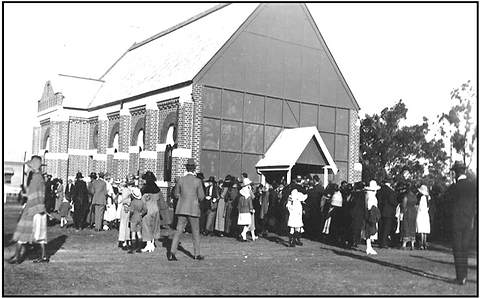
The Foundation Stone of the third Church of St Matthew was laid on Sunday, 4th March 1923, by the Archbishop of Brisbane, Dr Gerald Sharp.
The weekend of the 4th & 5th of August 1923 was a time of celebration for the Parish. On the Saturday was a dedication service for the temporary western wall, and on the Sunday a service of consecration for the church followed by the 8.00 am Communion Service. His Grace, Dr Gerald Sharp, Archbishop of Brisbane officiated at both services.
The Church is built in cruciform shape from red bricks manufactured at Darra, and is on a concrete foundation. A temporary weatherboard wall was erected at the western end with plans to complete the building at a later date.
The Rector was the Rev’d W. E. C. Barrett later Dean of St. John's Cathedral, the previous Rector having been the Rev’d, George Green, 1920 - 1922.
The last service before moving to the new church was held in the Parish Hall on 1st August 1923. The hall by this time had been transferred to land adjacent to the Church ground in Sherwood Road. It was later moved to its present site facing Oxley Road.
St Matthew’s, Sherwood 1923
Note Hall facing Sherwood Road.
The third church of St Matthew, dedication -1923.
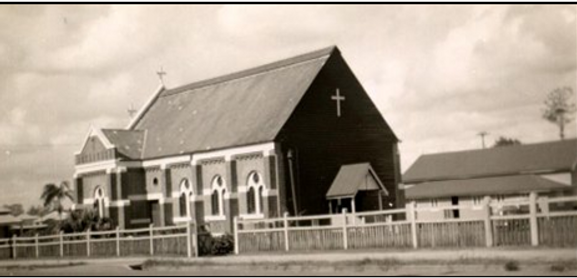
The church remained uncompleted for nearly four decades as this photograph from 1951 shows. Note that the Wooden Parish Hall has been relocated from fronting Sherwood Road to its location facing Oxley Road on the southern boundary. The fence has also undergone change from the 1923 photograph.
Photograph of the Wooden Hall circa late 1940’s or early 1950’s.
The extension to the Church was completed in December 1959, and dedicated on Sunday 14th February 1960, by His Grace the Archbishop of Brisbane, Archbishop Reginald Halse. The Rector was the Rev’d C. S. C. Arkell later Archdeacon Arkell.
The extended and completed church on dedication day 14 February, 1960.
Dedication was at the 7.00 am service.
Procession (below)
Rev Leslie Burrows,
Rev’d (later Bishop) Barry Hunter (Curate)
Rev’d C S C Arkell (Rector)
Archdeacon Frank Knight
Archbishop Reginald Halse
Bill Bracey (Server), John Tuffley (Server).
This the completed third Church of St Matthew along with its two predecessors has now served the local area for one hundred and fifty years.
Mrs Revell’s enjoiner in the late 1860s that “a church should be built” had resulted in three churches of St Matthew being erected.
By November 2019, the three churches totalling 150 years had been a very significant part of Sherwood and the surrounding suburbs. During their daily lives, motivated and influenced by part of Dr Tufnell’s sermon at the opening of the first church in 1870, as follows:
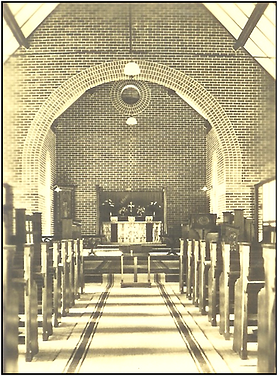
And to complete Margaret’s chronicle of the three churches of St Matthew we have included two interior photographs of the third church of St Matthew - one taken in 1923 and the second in 1950.
THIS PAGE IS A WORK IN PROGRESS PLEASE COME BACK.






Copy available from Editor
Rev’d Thomas (Tom) Hood Geordie from Newcastle upon Tyne, UK. Australian Bush Brother came to St Matthew’s during 1971. His tenure would last for the best part of twenty two years. Married to Joy. Much loved by all parishioners. Appointed a Canon in the latter part of his time at Sherwood. Bertha Cleminson in her writings which covered the early part of Tom’s ministry had this to say about him:
“Our parish of St Matthew’s is now under the guidance of our loved and respected Rector Thomas Hood. Quite a few changes in the interior of St Matthew’s church have been made at his instigation -
All of them pleasing and improving the whole atmosphere. It is good to see the Vestries coming to the west end of the church and according to the original plan. Moving the Rector’s Vestry permitted the removal of the remaining white wall which though intended to be temporary has lasted so long. The former Choir Vestry was dismantled in Archdeacon Arkell’s time and converted to the Mother’s Union Chapel. Now a new organ has been acquired (the third in the present church building) and as it refused to mount the stairs to the gallery it has found a place in the Sanctuary and the few remaining members of